
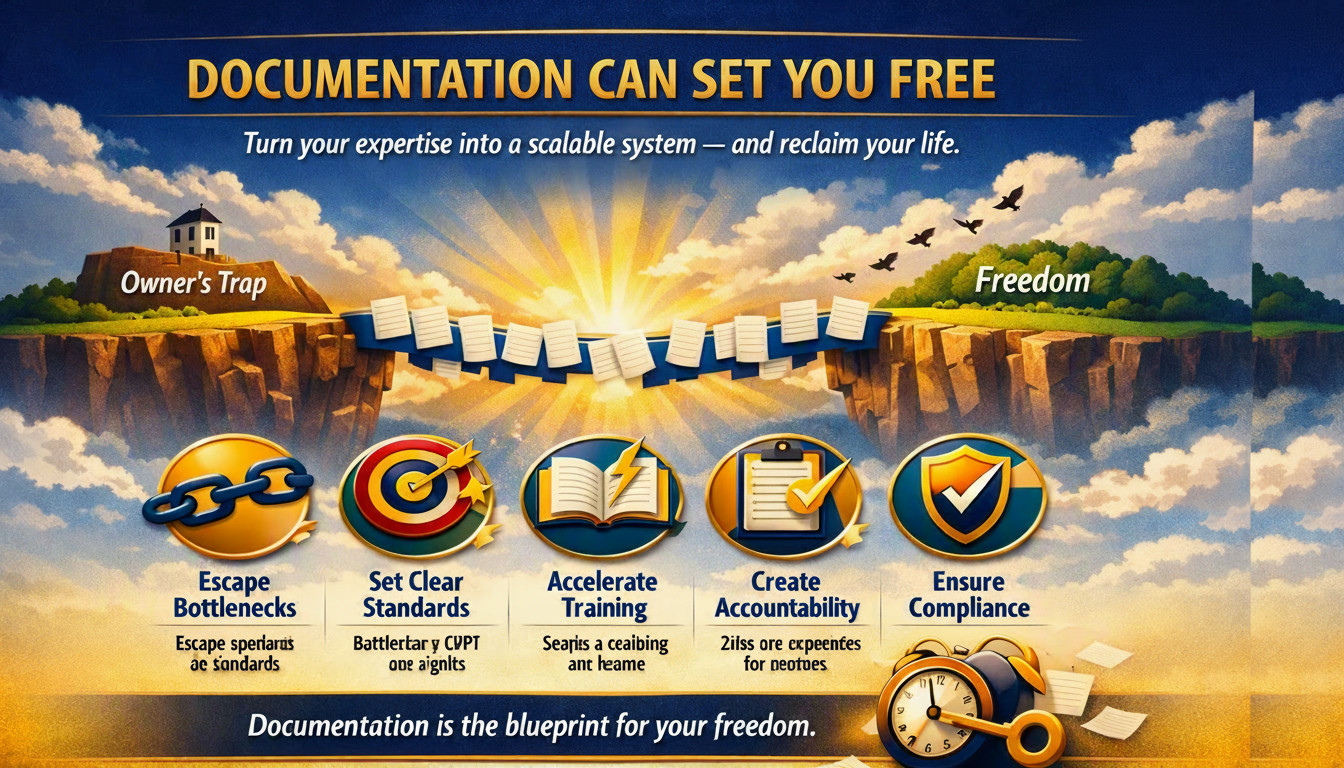
Documentation is the ultimate “freedom tool” for an owner. It is the bridge between your personal expertise and a scalable system. When you document your processes, you are essentially “cloning” your knowledge so that it can be applied by others, even when you aren’t in the room.
Here is how documentation specifically helps you escape the Owner’s Trap:
It Removes You as the “Single Point of Failure”
If only you know how to handle a specific Title 22 compliance issue or how to manage a particular vendor, you are a prisoner to that knowledge. If you get sick, go on vacation, or have a family emergency, the facility stalls.
The Documentation Fix: When you write down the “how-to” for critical tasks, you transfer that knowledge from your brain to the facility’s “operating system.” Now, your staff can step in and execute, ensuring your facility remains stable without your constant presence.
It Sets an Objective Standard
When you don’t have documented procedures, “doing it right” is whatever you say it is in the moment. This leads to inconsistency, which leads to you having to micromanage everything to ensure it’s done to your standard.
The Documentation Fix: A document acts as a neutral third party. It defines what “done right” looks like. When a staff member follows a documented procedure, they are meeting the facility’s standard, not just guessing what you want. This gives you the confidence to delegate.
It Accelerates Training and Onboarding
The biggest “time-drain” for an owner is repeatedly teaching the same thing to new employees. You end up spending hours in training that could be spent on strategic planning.
The Documentation Fix: With a library of Standard Operating Procedures (SOPs), onboarding becomes a structured, efficient process. Your new hires can learn the facility’s protocols by reading and practicing, rather than waiting for you to have a free hour to explain it to them.
It Creates Accountability
When a task isn’t documented, it’s easy for things to “slip through the cracks.” When you ask why something wasn’t done, the answer is often, “I didn’t know I was supposed to do it that way.”
The Documentation Fix: Documentation provides clarity. If it’s written down, there is no ambiguity. It allows you to hold your team accountable for results, which shifts your role from “supervisor of every task” to “manager of outcomes.”
It Protects Your Reputation and Compliance
In the RCFE/ARF world, your reputation relies on consistency. If your facility operates differently on a Tuesday with you than it does on a Saturday without you, your reputation is at risk.
The Documentation Fix: Documentation ensures that the level of care and the standard of compliance remain consistent, regardless of who is on shift. This consistency is exactly what regulators look for and what families trust.
Our Perspective:
Think of documentation as buying back your time. Every hour you spend writing a procedure today saves you ten hours of fixing mistakes, answering questions, and micromanaging tomorrow.
Start small:
Identify the three tasks you do every week that you hate the most.
Record yourself doing them or write down the steps clearly.
Hand that document to a staff member and ask them to perform the task using only your notes.
Refine the document based on their questions.
Once you have those three tasks off your plate, pick three more. This is how you reclaim your life and grow your business from a “job” into a true, scalable enterprise. You aren’t just writing instructions; you are writing the blueprint for your freedom.
You don’t have to do it all alone. Start small, start calm — and let documentation carry the weight for you.
We offer confidential guidance for owners ready to turn expertise into systems.