
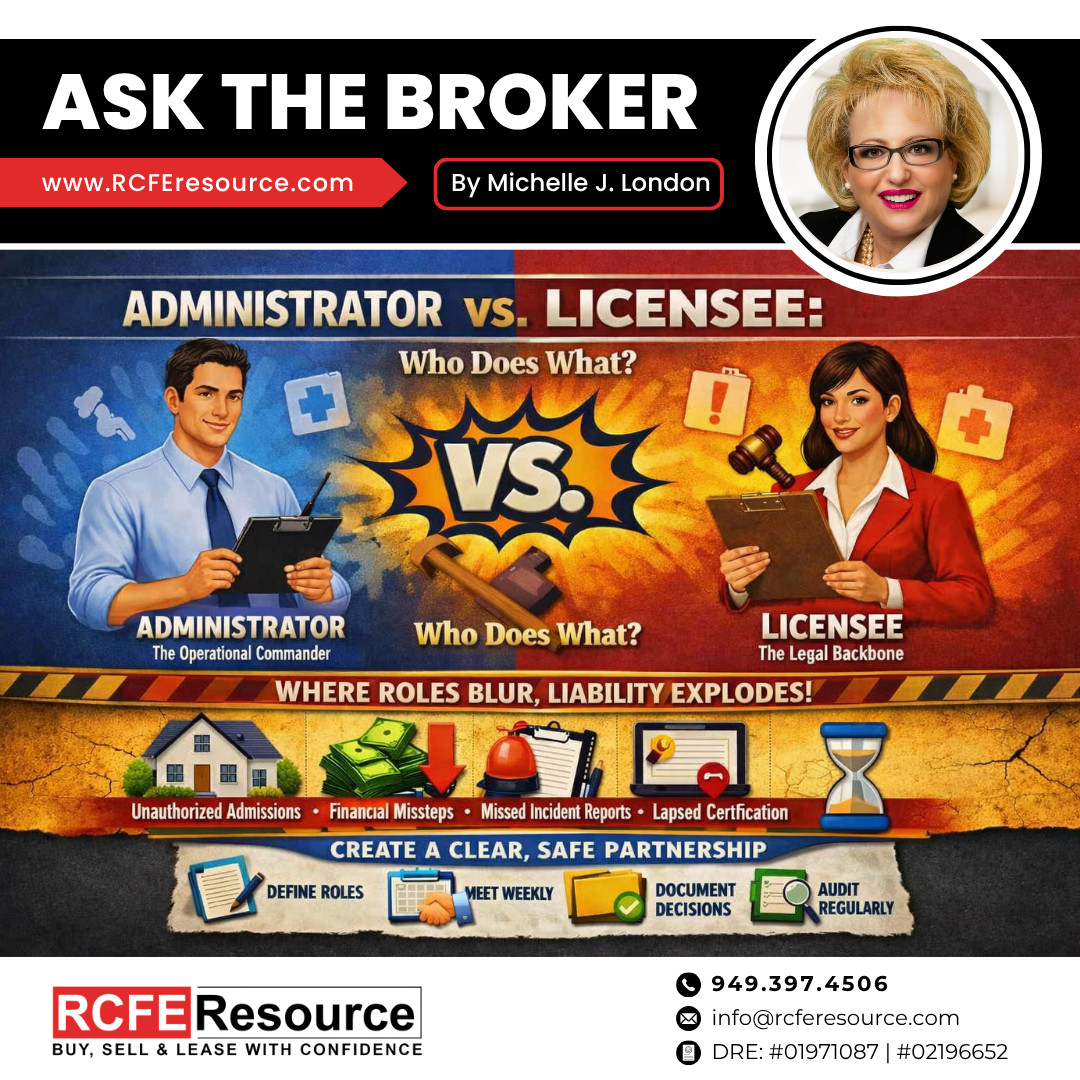
Q: Administrator vs. Licensee: Who Does What?
A: Confused roles lead to legal disasters. This article draws a hard line, so you delegate with precision.
In California residential care, nothing creates more liability than role confusion. When administrators start acting like licensees — or licensees assume administrators “have it handled” — the result is predictable: citations, fines, revoked licenses, and lawsuits.
This is the definitive breakdown of who does what, so your operation stays compliant, protected, and professionally managed.
THE LICENSEE: The Legal Backbone
The licensee is the person or entity legally responsible for the facility. They carry the weight of the license — and the consequences.
Core Responsibilities:
Ensuring full compliance with Title 22 and Health & Safety Code
Maintaining financial solvency, insurance, and operational oversight
Approving admissions, discharges, and major care decisions
Ensuring staffing ratios and qualifications are met
Overseeing administrator performance
Maintaining all regulatory documentation
Key Principle:
The licensee can delegate tasks — but never accountability.
If something goes wrong, the state looks to the licensee first.
THE ADMINISTRATOR: The Operational Commander
The administrator executes the day‑to‑day operations under the licensee’s authority.
Core Responsibilities:
Managing staff, schedules, and daily workflow
Ensuring resident care meets regulatory standards
Overseeing training, documentation, and incident reporting
Preparing for inspections and interacting with licensing analysts
Implementing policies and procedures
Maintaining their own certification and CEUs
Key Principle:
The administrator runs the operation — but does not own the liability. They are the captain on deck, but not the owner of the ship.
WHERE ROLES BLUR — AND LIABILITY EXPLODES
Most legal disasters come from one of these mistakes:
Administrator admits a resident without licensee approval
Licensee assumes the administrator is “handling everything”
Financial decisions made by the wrong person
Incident reports not escalated to the licensee
Administrator’s certification lapses without licensee oversight
Policies implemented without licensee review
When roles blur, compliance breaks.
HOW TO CREATE A CLEAR, SAFE PARTNERSHIP
Strong facilities operate with defined authority and documented expectations.
Put roles in writing — job descriptions, decision limits, escalation protocols
Meet weekly — review incidents, staffing, compliance, and census
Document decisions — protect both parties
Audit each other — internal checks prevent external citations
Clarity isn’t bureaucracy — it’s protection.
BOTTOM LINE
The licensee owns the responsibility.
The administrator owns the execution.
When both operate in alignment, your facility becomes safer, stronger, and legally protected.
Join The Discussion