
The “Owner’s Trap” is the point where your business stops being an asset you own and starts being a job that owns you. It happens when an operator becomes the “single point of failure” for every process, decision, and crisis in the facility.
In the RCFE/ARF world, this often manifests as the operator who insists on doing the grocery shopping, handles every staff conflict personally, and is the only person who knows how to navigate a licensing inspection.
Why the Owner’s Trap Kills Growth
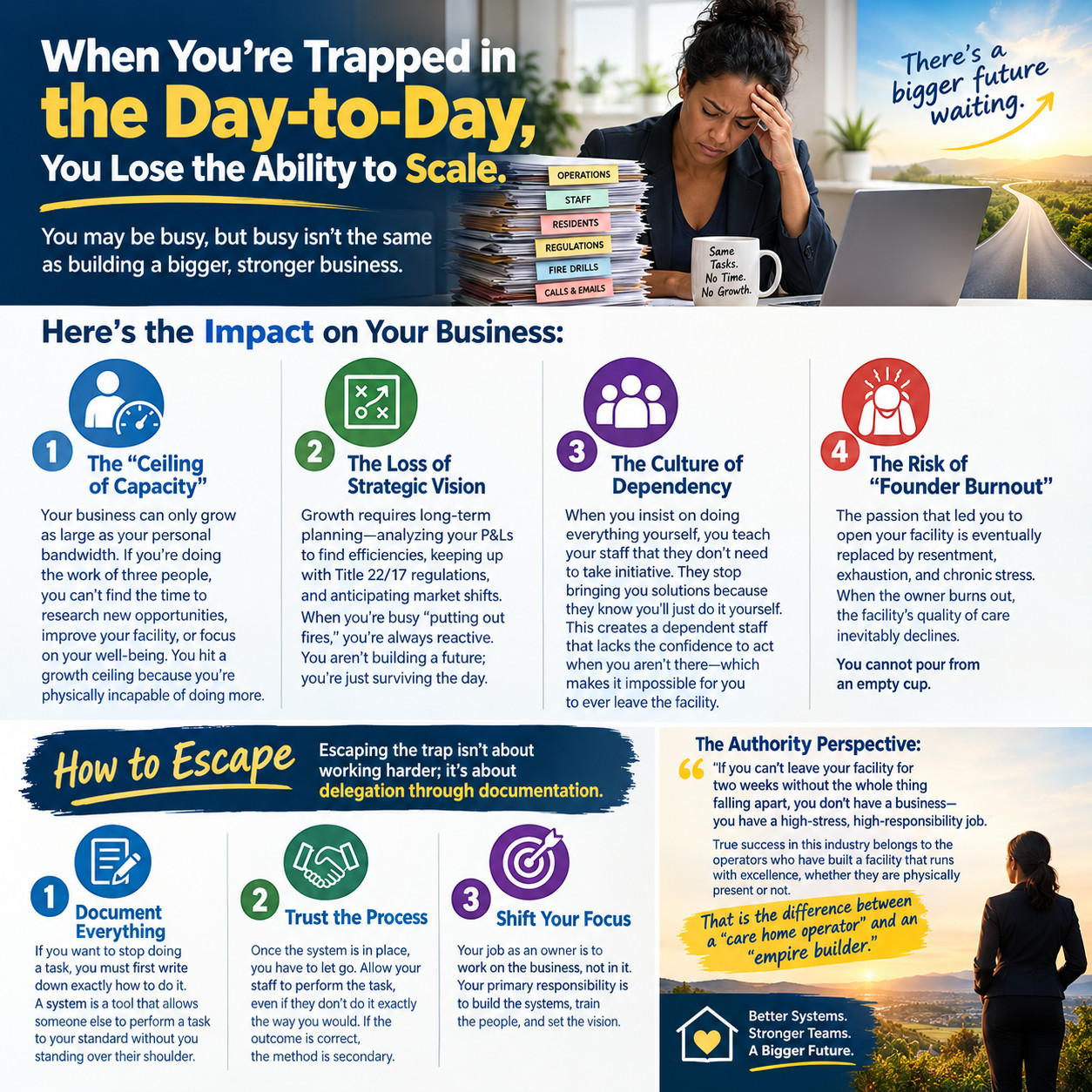
When you are trapped in the day-to-day, you lose the ability to scale. Here is the impact on your business:
The “Ceiling of Capacity”
Your business can only grow as large as your personal bandwidth. If you are doing the work of three people, you cannot possibly find the time to research new market opportunities, improve your facility’s infrastructure, or even focus on your own mental well-being. You hit a growth ceiling because you are physically incapable of doing more.
The Loss of Strategic Vision
Growth requires long-term planning—analyzing your P&Ls to find efficiencies, keeping up with changing Title 22/17 regulations, and anticipating market shifts. When you are busy “putting out fires,” you are always reactive. You aren’t building a future; you are just surviving the day.
The Culture of Dependency
When you insist on doing everything yourself, you inadvertently teach your staff that they don’t need to take initiative. They stop bringing you solutions because they know you’ll just do it yourself. This creates a dependent staff that lacks the confidence to act when you aren’t there—which, in turn, makes it impossible for you to ever leave the facility.
The Risk of “Founder Burnout”
The most dangerous impact is on you. The passion that led you to open your facility is eventually replaced by resentment, exhaustion, and chronic stress. When the owner burns out, the facility’s quality of care inevitably declines. You cannot pour from an empty cup.
How to Escape
Escaping the trap isn’t about working harder; it’s about delegation through documentation.
Document Everything: If you want to stop doing a task, you must first write down exactly how to do it. A system is a tool that allows someone else to perform a task to your standard without you standing over their shoulder.
Trust the Process: Once the system is in place, you have to let go. You have to allow your staff to perform the task, even if they don’t do it exactly the way you would. If the outcome is correct, the method is secondary.
Shift Your Focus: Your job as an owner is to work on the business, not in it. Your primary responsibility is to build the systems, train the people, and set the vision.
Our Perspective:
If you can’t leave your facility for two weeks without the whole thing falling apart, you don’t have a business—you have a high-stress, high-responsibility job. True success in this industry belongs to the operators who have built a facility that runs with excellence, whether they are physically present or not. That is the difference between a “care home operator” and an “empire builder.”
Sometimes, the first step toward growth is simply taking a step back and looking at the business from a different perspective. If you’d like to explore that, we’re always available for a confidential conversation.